Two Windows features generate endless debate in gaming communities: Game Mode and Hardware Accelerated GPU Scheduling. Some swear these settings transformed their gaming experience. Others insist they cause problems and should be disabled immediately. After extensive testing across multiple systems and dozens of games, I’ve found the truth is more nuanced than either extreme suggests.
Both features aim to optimize how Windows handles gaming workloads, but they operate very differently. Understanding what each actually does, rather than relying on forum speculation, helps you make informed decisions about whether to enable them on your specific system.
What Game Mode actually does
Game Mode isn’t a magic performance boost button. It’s a collection of system behavior modifications designed to prioritize your gaming session over background Windows activities.
Background process management: When Game Mode detects an active game, Windows reduces the priority of background processes. This doesn’t kill these processes, it simply ensures your game gets CPU time first when resources are contested. The effect is most noticeable on systems with fewer CPU cores or when running multiple background applications.
Windows Update prevention: Game Mode prevents Windows Update from installing drivers or performing system updates while you’re gaming. This eliminates the nightmare scenario of Windows deciding to restart mid-match or installing a graphics driver that crashes your game. Updates queue until your gaming session ends.
Notification suppression: System notifications are suppressed during gaming, preventing pop-ups from stealing focus or causing momentary frame drops. This works alongside Focus Assist but provides gaming-specific handling.
Memory optimization: Windows adjusts memory allocation priorities to favor your active game. Background applications may experience slightly reduced memory availability, ensuring your game has adequate RAM for asset loading and caching.
Testing Game Mode’s real impact
I tested Game Mode extensively on my primary gaming system: Ryzen 7 7800X3D with RTX 4070 Ti and 32GB DDR5 RAM across various titles and scenarios.
Clean system testing: On a fresh Windows installation with minimal background applications, Game Mode provided negligible FPS improvements, typically within margin of error (1-2 FPS variation). This makes sense because there’s little competing for resources.
Realistic usage testing: With typical background applications running (Discord, browser with multiple tabs, Spotify, monitoring software), Game Mode showed measurable benefits. Frame time consistency improved by 3-5%, with fewer micro-stutters during gameplay. The improvement was more noticeable in CPU-intensive games like Cities: Skylines 2 and Civilization VI.
Older game compatibility: Testing games from 2015-2018 revealed occasional issues. A handful of titles exhibited increased stuttering or unusual behavior with Game Mode enabled. Modern games (2020 onwards) universally benefited or showed no difference.
Streaming while gaming: Game Mode significantly helped when streaming via OBS. The priority management reduced encoder frame drops and maintained more consistent game performance during simultaneous streaming.
How to configure Game Mode
Game Mode configuration is straightforward but worth verifying, as troubleshooting steps sometimes disable it.
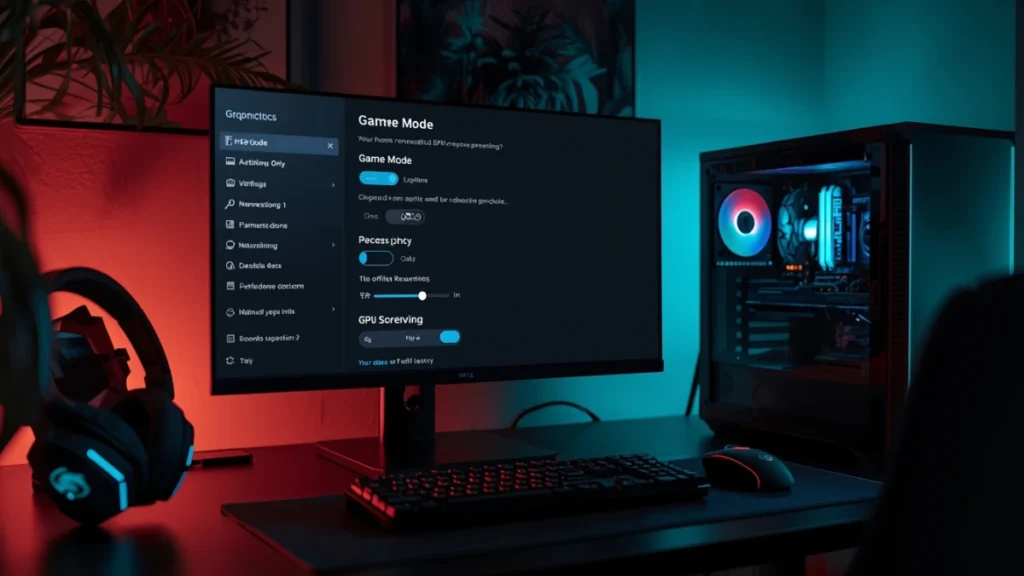
Enabling Game Mode: Navigate to Settings > Gaming > Game Mode. Ensure the toggle is set to On. Windows 11 enables this by default on fresh installations. For Windows 11-specific optimizations beyond Game Mode, see the Windows 11 gaming optimization settings guide.
Verifying activation: Game Mode activates automatically when Windows detects a game. You can verify it’s working by pressing Win+G during gameplay to open Xbox Game Bar, which indicates Game Mode status.
Per-game behavior: Windows maintains a database of recognized games. Most popular titles are automatically recognized. If a game isn’t detected, adding it through Xbox Game Bar can force Game Mode activation.
When to disable: If you experience issues with specific older games: unusual stuttering, input problems, or crashes that don’t occur with Game Mode off, disable it for troubleshooting. Create a shortcut with Game Mode disabled for problematic titles while keeping it enabled system-wide.
Understanding Hardware Accelerated GPU Scheduling
HAGS represents a more fundamental change to how Windows manages GPU resources. Unlike Game Mode’s process priority adjustments, HAGS restructures the relationship between your CPU and GPU.
Traditional GPU scheduling: Without HAGS, your CPU manages GPU memory scheduling through the Windows Display Driver Model (WDDM). The CPU maintains queues of rendering commands and handles memory allocation for GPU tasks. This works but adds CPU overhead and latency.
HAGS operation: With HAGS enabled, the GPU’s dedicated scheduling processor handles its own memory management. The CPU sends high-level commands while the GPU manages the detailed scheduling internally. This reduces CPU overhead and can lower latency by eliminating the CPU middleman.
Hardware requirements: HAGS requires compatible hardware and drivers:
- Windows 10 version 2004 or Windows 11
- NVIDIA GTX 1000-series or newer (Pascal and later)
- AMD RX 5000-series or newer (RDNA and later)
- Intel Arc graphics
- Updated graphics drivers with HAGS support
HAGS performance testing results
I tested HAGS across the same system configuration, measuring both FPS and input latency using specialized tools.
Latency measurements: Using NVIDIA’s Reflex Latency Analyzer with a compatible monitor, I measured consistent 1-2ms latency reduction with HAGS enabled across tested titles. This improvement was present regardless of whether the game supported NVIDIA Reflex natively.
FPS impact: Raw framerate differences were minimal, typically within 1-2% in either direction depending on the game. Some titles showed slight improvement; others showed slight decrease. The differences weren’t significant enough to matter for most players.
Frame time consistency: HAGS slightly improved frame time consistency in GPU-limited scenarios. The improvement was subtle but measurable in frame time graphs, fewer small spikes during normal gameplay.
CPU overhead reduction: Monitoring CPU usage during gaming showed marginally lower CPU overhead with HAGS enabled, particularly in titles that generate many draw calls. The reduction freed CPU resources for other tasks.
HAGS compatibility considerations
Despite being available for several years, HAGS still causes issues with certain games and configurations.
Known problematic scenarios:
- Some older DirectX 9 and DirectX 10 games exhibit graphical glitches or crashes
- Certain anti-cheat systems have reported conflicts (though most have been resolved)
- Hardware video encoding can sometimes behave unexpectedly
- Multiple monitor setups occasionally experience issues with window management
Testing methodology: If you’re uncertain about HAGS on your system, enable it and test your most-played games thoroughly. Play for at least 30 minutes each, monitoring for graphical glitches, crashes, or unusual behavior. Keep notes on any issues encountered.
Safe approach: HAGS is worth enabling on modern systems with recent GPU architectures (RTX 30/40 series, RX 6000/7000 series). The latency benefits are real, and compatibility issues are increasingly rare with current drivers.
Enabling and configuring HAGS
HAGS configuration requires accessing graphics settings and restarting your system.
Enabling HAGS: Navigate to Settings > System > Display > Graphics > Default graphics settings. Toggle “Hardware-accelerated GPU scheduling” to On. A system restart is required for the change to take effect.
Verifying HAGS status: After restart, return to the same settings page to confirm HAGS shows as enabled. Some driver installations can reset this setting.
Driver considerations: Ensure your graphics drivers are current before enabling HAGS. Older drivers may have HAGS bugs that newer versions resolved. Both NVIDIA and AMD have improved HAGS compatibility significantly in recent driver releases.
Combining Game Mode and HAGS
These features aren’t mutually exclusive, they address different aspects of gaming optimization and can work together effectively.
Recommended configuration for modern systems:
- Game Mode: Enabled
- HAGS: Enabled
- This combination provides both the process priority benefits of Game Mode and the latency reduction of HAGS
Troubleshooting approach: If you experience issues, disable one feature at a time to identify the culprit. Game Mode issues typically manifest as stuttering or process-related problems. HAGS issues usually appear as graphical glitches or crashes.
System-specific considerations: Lower-end systems with limited CPU resources benefit more from Game Mode’s process management. Higher-end systems with modern GPUs benefit more from HAGS’s latency reduction. Both benefit most systems to some degree.
When these features matter most
Understanding when these optimizations provide meaningful benefit helps set realistic expectations.
Game Mode matters most when:
- Running background applications during gaming
- Using systems with 4-6 CPU cores
- Streaming while gaming
- Playing CPU-intensive titles
- Using systems with 16GB or less RAM
HAGS matters most when:
- Playing competitive games where input latency is critical
- Using VRR displays (G-Sync/FreeSync)
- Playing games with high draw call counts
- Seeking to reduce system latency holistically
Minimal impact scenarios:
- Clean systems with no background applications
- Already achieving very high framerates (300+ FPS)
- GPU-limited scenarios at high resolutions
- Playing older games that may have compatibility issues
The debate around these features often misses that their impact is situational. Neither is universally beneficial or harmful, they’re tools that provide specific benefits under specific conditions. Test them on your system with your games, measure the results, and configure based on evidence rather than forum opinions.
Game Mode and HAGS are just two pieces of the puzzle. For a full breakdown of every Windows setting that impacts gaming, see the complete Windows gaming optimization guide.